




The winter of 2000/2001 was bitterly cold in many parts of Asia; in fact, many cold-temperature records were set. According to NBC News correspondent Dana Lewis, extreme cold blasted Russia into the coldest winter in a century, while from Siberia to the Far East, bone-chilling temperatures some 30 degrees below normal made it "a battle just to survive."
Similar information was obtained from a report by Red Cross staff writer Stephanie Kriner, who wrote about some other cold-induced disasters. She reported, for example, that in the first week of January 2001, many people died "as a result of a bitter cold front sweeping across northern India," which brought "the coldest temperatures to hit the region in several years." Kriner noted that the same cold front also swept into Pakistan, threatening the lives of hundreds of thousands of Afghan refugees. In China, she said that "the worst winter weather conditions in decades" left many people dead, and that Barbara Wetsig of the American Red Cross feared that thousands of other people were "at risk of frostbite, hypothermia and starvation," especially "the poor, homeless, elderly and children." In fact, Kriner noted that the Inner Mongolian Branch of the Russian Red Cross estimated that up to 1.35 million people were affected. She also reported that "the worst snowstorm in 50 years" stranded "tens of thousands of herders and their livestock" in Inner Mongolia, and that blizzards paralyzed South Korea in what weather forecasters there described as "the worst snowstorm in 20 years," adding that the Central Asian state of Kazakhstan was subjected to "its coldest winter weather in 40 years."
At a time when we're told that the world is hotter than it's been over the past thousand or more years, this information is not exactly what one would expect to hear, unless, of course, the claim is wrong. And, in fact, that is what it appears to be; for a number of real-world (as opposed to climate-model) studies provide evidence that Asian temperatures during the first half of the past century and earlier were sometimes much warmer than they have been over the past couple of decades. And some of them suggest that temperature trends of the past few decades have actually been negative, rather than positive.
Kadioglu et al. (2001), for example, analyzed temperature trends in Turkey over the period 1930-1996, finding significant cooling during this time interval. Likewise, Zeeberg and Forman (2001) also found a recent decline in temperature for the Russian Island of Novaya Zemlya. Reporting initially on a significant post-Little Ice Age glacial retreat that occurred there during the first and second decades of the 20th Century, they found that in the second half of the last century the recession of over half of the glaciers stopped; and many tidewater glaciers began to advance, likely provoked by a sudden cooling, where in the last four decades of the century, summer temperatures declined by 0.3 to 0.5°C and winter temperatures declined by 2.3 to 2.8°C.
Additional data supporting a regional cooling in Asia since the mid-20th century come from Vaganov et al. (2000). In analyzing temperature variations of the Asian subarctic, they reported a cooling trend since about 1940. Furthermore, analyses of their data, which extended back in time some 600 years, revealed that the amplitude of 20th century warming "does not go beyond the limits of reconstructed natural temperature fluctuations in the Holocene subarctic zone." These findings have also been confirmed by Naurzbaev and Vaganov (2000), who analyzed a 2200-year temperature record derived from Siberian tree rings over the period 212 BC to AD 1996. Several warm and cold periods were noted throughout their 2000-year record: a cool period in the first two centuries AD, a warm period from AD 200 to 600, cooling again from AD 600 to 800, followed by the Medieval Warm Period from about AD 850 to 1150, the cooling of the Little Ice Age from AD 1200 through 1800, followed by the recovery warming of the 20th century. But with respect to this latter warming, they note that it was "not extraordinary" and that "the warming at the border of the first and second millennia [AD 1000] was longer in time and similar in amplitude." Also, reconstructed temperatures for the mid-Holocene, approximately 5000 years ago, revealed an even warmer time period, when temperatures averaged 3.3°C higher than those of the past two millennia.
A short time later, Yadav and Singh (2002) developed a spring (March-May) temperature reconstruction for the western Himalayan region of India (approximately 30.5-31°N, 78.7-79.7°E), based on a network of twelve tree-ring chronologies of Himalayan cedar (Cedrus deodara (D. Don) G. Don). And in doing so, they found that "the most conspicuous feature of the temperature reconstruction is the long-term cooling trend since the late 17th century that ended early in the 20th century." And the abrupt termination of this cooling, which had heralded the end of the Little Ice Age, soon thereafter produced the warmest 30-year period of the 20th century (1945-1974). This warm interval, however, was "well within the range of natural variability," as Yadav and Singh describe it; for there was an even warmer 30-year period in the latter part of the 17th century (1662-1691).
In comparing their temperature reconstruction with that of Mann et al. (1999), the two scientists also noted that there was no correlation between the two temperature histories prior to the 20th century. And another discrepancy began where both tree-ring reconstructions ended; for whereas the subsequent instrumental record reported by Mann et al. indicates especially dramatic warming over the last two decades of the 20th century, the instrumental record reported by Yadav and Singh indicates cooling, as is also indicated by several other studies they cite that are based on both instrumental and tree-ring observations, such as those of Esper et al. (2002a,b).
Contemporaneously, Yao et al. (2002) derived a 2000-year proxy temperature (ð18O) history from an ice core retrieved from Dasuopu glacier (28°23'N, 85°43'E), which is located in the central Himalayas of Tibet. This history indicated that temperature in the first century A.D. "was low and followed by a significant increase until 730 AD," whereupon it "reached its maximum during 730-950 AD, then it lowered again, which persisted until 1850 AD," after which "temperature has increased gradually to its present levels." These intervals correspond, respectively, to the Dark Ages Cold Period, the Medieval Warm Period, the Little Ice Age and, near the very end of the record, the Modern Warm Period, which distinctive climatic regimes are evident in the records of many sites from all around the world. They demonstrate the reality of a millennial-scale climate cycle that operates independently of changes in the air's CO2 content. In addition, the Dasuopu temperature record demonstrates the importance of considering more than just the past thousand years when attempting to gain an appreciation for the degree of natural climate variability one must consider when attempting to assign a cause to the temperature increase of the past century and a half. In the words of the ten researchers, "if we just analyze temperature changes in [the] recent 1 ka, we may draw a wrong conclusion that [the] temperature recorded in [the] Dasuopu ice core goes beyond the natural variability range [near its end]," which is one of the major mistakes made by Mann et al. (1998, 1999).
One year later, Esper et al. (2003) processed several extremely long juniper ring-width chronologies for the Alai Range of the western Tien Shan in Kirghizia in such a way as to preserve multi-centennial growth trends that they say are typically "lost during the processes of tree ring data standardization and chronology building," citing Cook and Kairiukstis (1990) and Fritts (1976). That is to say, they used two techniques that maintain low frequency signals: long-term mean standardization (LTM) and regional curve standardization (RCS).
Carried back in time a full thousand years, the LTM and RCS chronologies show long-term decreasing trends until about AD 1600, broad minima from 1600 to 1800, and long-term increasing trends from about 1800. And as a result, in the words of Esper et al., "the main feature of the LTM and RCS Alai Range chronologies is a multi-centennial wave with high values towards both ends."
This grand result has essentially the same form as the Northern Hemisphere extra-tropic temperature history of Esper et al. (2002a), which is vastly different from the notorious hockeystick temperature history of Mann et al. (1998, 1999) and Mann and Jones (2003), in that it depicts the existence of both the Little Ice Age and the preceding Medieval Warm Period, which are nowhere to be found in the Mann and Company reconstructions. And the new result - especially the LTM chronology, which has a much smaller variance than the RCS chronology - depicts several periods in the first half of the last millennium that were warmer than any part of the last century. These periods include much of the latter half of the Medieval Warm Period and a good part of the first half of the 15th century, which has also been found to have been warmer than it is currently by both McIntyre and McKitrick (2003) and Loehle (2004).
About this same time, Cook et al. (2003) developed a 400-year temperature history of the Himalayan region of Nepal, which they describe as "the best yet produced from the 'High Asia' region spanning the Himalayas, Karakoram, and Tibetan Plateau," using 32 tree-ring chronologies based on five indigenous tree species and a monthly temperature record from the Indian Embassy in Kathmandu that stretches from 1879 to 1977, which they updated to 1992 with records from nearby meteorological stations located at comparable elevations. This work revealed that their temperature reconstructions (Feb-Jun and Oct-Feb) "reflect patterns of temperature variability associated with Little Ice Age cooling and warming into the 20th century," which was only to be expected. But what about the supposedly "unprecedented" warming of the past quarter-century, which climate alarmists claim has been cooking the world?
The US and British scientists report that "only the October-February reconstruction shows any indication of unusual late-20th century warming," but they fail to note that the temperatures of which they speak were not as great as those experienced a century earlier. Hence, for the Oct-Feb season, there was no net warming, and maybe even a slight cooling, over the last hundred years of data availability. As for the other part of the year (Feb-Jun), there actually was a net cooling, with temperatures dropping dramatically through the late 1950s and early 60s and remaining below the long-term average to the end of the record.
Continuing to focus on the Himalayas, Yadav et al. (2004) used many long tree-ring series obtained from widely-spaced Himalayan cedar (Cedrus deodara (Roxb.) G. Don) trees growing on steep slopes with thin soil cover to develop a temperature history of the western Himalayas for the period AD 1226-2000. This work revealed that 1944-1953 was the warmest 10-year mean of the entire 775-year record, and that "thereafter, temperatures decreased." With respect to this cooling, they also noted that it was "in agreement with the instrumental records." In addition, they stated that "tree-ring based temperature reconstructions from other Asian mountain regions like Nepal (Cook et al., 2003), Tibet and central Asia (Briffa et al., 2001) also document cooling during [the] last decades of the 20th century." In fact, the temperatures of the final two decades of Yadav et al.'s record appear to be as cold as those of any comparable period over the prior seven and a half centuries, including the coldest periods of the Little Ice Age, which result, as they indicate, is radically different from the temperature reconstruction of Mann and Jones (2003) that depicts "unprecedented warming in the 20th century."
Creeping ahead one more year, Feng and Hu (2005) derived decadal surface air temperatures for the last two millennia from ice core and tree-ring data acquired at five locations on the Tibetan Plateau. This effort revealed that the late 20th century was the warmest period of the past two millennia at two of the sites (Dasuopu, ice core; Dunde, ice core); but such was not the case at the other three sites (Dulan, tree ring; South Tibetan Plateau, tree ring; Guilya, ice core). At Guilya, for example, the data indicated it was significantly warmer than it was in the final two decades of the 20th century for most of the first two centuries of the record, which comprised the latter part of the Roman Warm Period. And at the South Tibetan Plateau, it was also significantly warmer over another full century near the start of the record; while at Dulan it was significantly warmer for the same portion of the Roman Warm Period plus two near-century-long portions of the Medieval Warm Period.
Shortly thereafter, Delbart et al. (2006) - in a very different type of study - developed a methodology for determining the day of year onset of greening in the 1982-2004 period using SPOT-VEGETATION (VGT) and NOAA Advanced Very High Resolution Radiometer (AVHRR) data. Applying this technique to the vast area of northern Eurasia that is located between latitudes 50°N and 72°N and between longitudes 45°E and 180°E, they obtained the data portrayed in the figure below, where it can be seen that between the starting and end points of the data series (1982 and 2004), there was no net advance in spring phenology. And when a third-degree polynomial is fit to the data, it can be seen that the long slow advance of spring greening that prevailed over the initial two-thirds of the series reversed course over the last third of its range to rapidly return to where it was initially.
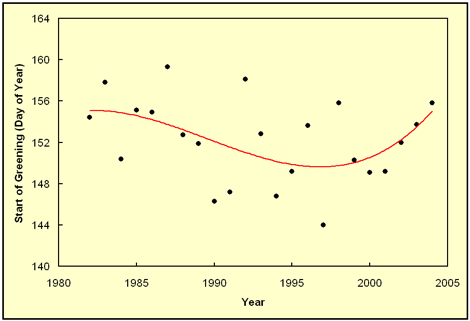
Yearly history of the spring "greening" of northern Eurasia's vegetation.
Consequently, if the advancement and retraction of the onset of spring greening portrayed in the figure above is driven respectively by warming and cooling, as seems only natural, it would appear that (1) there was no net change in the thermal climate of northern Eurasia between 1982 and 2004, and that (2) the vast area looks primed for a continuation of the implied end-period cooling trend for some time beyond 2005.
About this same time, Fowler and Archer (2006) examined temperature data from seven sites scattered throughout the Karakoram and Hindu Kush Mountains of the Upper Indus Basin (a 200-km x 300-km area) of India, looking for seasonal and annual trends over the period 1961-2000, after which implications of the results for glacier behavior within the region were assessed and compared with actual glacier observations. This work first revealed, in the words of the two researchers, that "on average, climate stations in the Upper Indus Basin show a reduction in mean summer temperature of 1.2°C over the period 1961-2000." In addition, they report that Archer and Fowler (2004) had determined that "climate stations in the Karakoram show consistent positive trends in winter precipitation, averaging a 7% increase per decade for the period since 1961."
Taken together, Fowler and Archer say that "summer temperature reductions and positive trend in winter precipitation imply reduced ablation and increased accumulation of Karakoram glaciers," and they note in this regard that "these climatic changes are consistent with the observed thickening and expansion of glaciers in the Upper Indus Basin region," where they say that "Hewitt (1998) reports the widespread expansion of larger glaciers in the central Karakoram, accompanied by an exceptional number of glacier surges." And later still, Dash and Mamgain (2011) reported that a significant increasing trend in the number of warm days in summer is noticed "only in the interior peninsula" of India.
In conclusion, and in light of the several findings referenced above, it is difficult to see how climate alarmists can continue to claim that 20th century warming was unprecedented over the past millennium. Clearly, this has not been the case for various parts of Asia, many of which have in fact exhibited negative temperature trends that are in direct contradiction of climate-alarmist claims.
References
Archer, D.R. and Fowler, H.J. 2004. Spatial and temporal variations in precipitation in the Upper Indus Basin, global teleconnections and hydrological implications. Hydrology and Earth System Sciences 8: 47-61.
Briffa, K.R., Osborn, T.J., Schweingruber, F.H., Harris, I.C., Jones, P.D., Shiyatov, S.G. and Vaganov, E.A. 2001. Low frequency temperature variations from northern tree ring density network. Journal of Geophysical Research 106: 2929-2941.
Cook, E.R. and Kairiukstis, L.A. 1990. Methods of Dendrochronology: Applications in the Environmental Sciences. Kluwer, Dordrecht, The Netherlands.
Cook, E.R., Krusic, P.J. and Jones, P.D. 2003. Dendroclimatic signals in long tree-ring chronologies from the Himalayas of Nepal. International Journal of Climatology 23: 707-732.
Dash, S.K. and Mamgain, A. 2011. Changes in the frequency of different categories of temperature extremes in India. Journal of Applied Meteorology and Climatology 50: 1842-1858.
Delbart, N., Le Toan, T., Kergoat, L. and Fedotova, V. 2006. Remote sensing of spring phenology in boreal regions: A free of snow-effect method using NOAA-AVHRR and SPOT-VGT data (1982-2004). Remote Sensing of Environment 101: 52-62.
Esper, J., Cook, E.R. and Schweingruber, F.H. 2002a. Low-frequency signals in long tree-ring chronologies for reconstructing past temperature variability. Science 295: 2250-253.
Esper, J., Schweingruber, F.H. and Winiger, M. 2002b. 1300 years of climatic history for Western Central Asia inferred from tree-rings. The Holocene 12: 267-277.
Esper, J., Shiyatov, S.G., Mazepa, V.S., Wilson, R.J.S., Graybill, D.A. and Funkhouser, G. 2003. Temperature-sensitive Tien Shan tree ring chronologies show multi-centennial growth trends. Climate Dynamics 21: 699-706.
Feng, S. and Hu, Q. 2005. Regulation of Tibetan Plateau heating on variation of Indian summer monsoon in the last two millennia. Geophysical Research Letters 32: 10.1029/2004GL021246.
Fowler, H.J. and Archer, D.R. 2006. Conflicting signals of climatic change in the Upper Indus Basin. Journal of Climate 19: 4276-4293.
Fritts, H.C. 1976. Tree Rings and Climate. Academic Press, London, United Kingdom.
Hewitt, K. 1998. Glaciers receive a surge of attention in the Karakoram Himalaya. EOS, Transactions, American Geophysical Union 79: 104-105.
Kadioglu, M., Sen, Z. and Gültekin, L. 2001. Variations and trends in Turkish seasonal heating and cooling degree-days. Climatic Change 49: 209-223.
Loehle, C. 2004. Climate change: detection and attribution of trends from long-term geologic data. Ecological Modelling 171: 433-450.
Mann, M.E., Bradley, R.S. and Hughes, M.K. 1998. Global-scale temperature patterns and climate forcing over the past six centuries. Nature 392: 779-787.
Mann, M.E., Bradley, R.S. and Hughes, M.K. 1999. Northern Hemisphere temperatures during the past millennium: Inferences, uncertainties, and limitations. Geophysical Research Letters 26: 759-762.
Mann, M.E. and Jones, P.D. 2003. Global surface temperatures over the past two millennia. Geophysical Research Letters 30: 10.1029/2003GL017814.
McIntyre, S. and McKitrick, R. 2003. Corrections to the Mann et al. (1998) proxy data base and Northern Hemispheric average temperature series. Energy and Environment 14: 751-771.
Naurzbaev, M.M. and Vaganov, E.A. 2000. Variation of early summer and annual temperature in east Taymir and Putoran (Siberia) over the last two millennia inferred from tree rings. Journal of Geophysical Research 105: 7317-7326.
Vaganov, E.A., Briffa, K.R., Naurzbaev, M.M., Schweingruber, F.H., Shiyatov, S.G. and Shishov, V.V. 2000. Long-term climatic changes in the arctic region of the Northern Hemisphere. Doklady Earth Sciences 375: 1314-1317.
Yadav, R.R., Park, W.K., Singh, J. and Dubey, B. 2004. Do the western Himalayas defy global warming? Geophysical Research Letters 31: 10.1029/2004GL020201.
Yadav, R.R. and Singh, J. 2002. Tree-ring-based spring temperature patterns over the past four centuries in western Himalaya. Quaternary Research 57: 299-305.
Yao, T., Thompson, L.G., Duan, K., Xu, B., Wang, N., Pu, J., Tian, L., Sun, W., Kang, S. and Qin, X. 2002. Temperature and methane records over the last 2 ka in Dasuopu ice core. Science in China (Series D) 45: 1068-1074.
Zeeberg, J. and Forman, S.L. 2001. Changes in glacier extent on north Novaya Zemlya in the twentieth century. Holocene 11: 161-175.
Last updated 4 December 2013